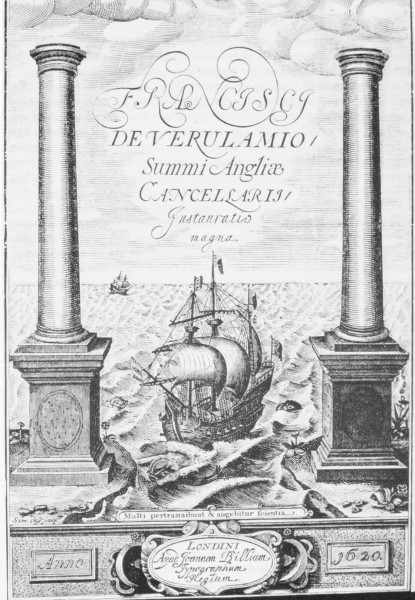

Summary of Francis Bacon’s New Organon theory of the Four Idols of Knowing

In Book I of the New Organon (Aphorisms 39-68), Bacon introduces his famous doctrine of the “idols.” These are characteristic errors, natural tendencies, or defects that beset the mind and prevent it from achieving a full and accurate understanding of nature. Bacon points out that recognizing and counteracting the idols is as important to the study of nature as the recognition and refutation of bad arguments is to logic. Incidentally, he uses the word “idol” – from the Greek eidolon (“image” or “phantom”) – not in the sense of a false god or heathen deity but rather in the sense employed in Epicurean physics. Thus a Baconian idol is a potential deception or source of misunderstanding, especially one that clouds or confuses our knowledge of external reality.
Bacon identifies four different classes of idol. Each arises from a different source, and each presents its own special hazards and difficulties.
# 1. The Idols of the Tribe. These are the natural weaknesses and tendencies common to human nature. Because they are innate, they cannot be completely eliminated, but only recognized and compensated for. Some of Bacon’s examples are:
# Our senses – which are inherently dull and easily deceivable. (Which is why Bacon prescribes instruments and strict investigative methods to correct them.)
# Our tendency to discern (or even impose) more order in phenomena than is actually there. As Bacon points out, we are apt to find similitude where there is actually singularity, regularity where there is actually randomness, etc.
# Our tendency towards “wishful thinking.” According to Bacon, we have a natural inclination to accept, believe, and even prove what we would prefer to be true.
# Our tendency to rush to conclusions and make premature judgments (instead of gradually and painstakingly accumulating evidence).”
a summary from Francis Bacon [Internet Encyclopedia of Philosophy].
Buy the entire ebook NOVUM ORGANUM including the entire Four Idols theory
 Novum Organum FREE sample pages. Does not include the Four Idols Theory