Current AffairsResearch

Life came to Earth on Comets? First Alien Encounter?

Algae-like biological entities were found in outer space in July 2013 by Sheffield University researchers, who collected the little critters on sterile studs of a balloon launched not far from Liverpool, UK. Researchers believe the entities did not originate on Earth. Likely source: comets. Panspermia theory of life origin thus gets a second wind.

MORE BIOLOGICAL ENTITIES FROM THE STRATOSPHERE INCLUDING A DIATOM FRAGMENT-FURTHER EVIDENCE FOR A SPACE ORIGIN – Journal of Cosmology

Milton Wainwright, Christopher E. Rose, Alexander J. Baker and N. Chandra Wickramasinghe

Details of stratosphere-isolated biomorphs are given, including a fragment of a diatom frustule and an  inorganic particle-rich mass containing biological filaments. We argue that this mass which is around 300 micron in size is, like the other biological entities shown, too large to have been carried from Earth to the stratosphere. As a result, we conclude that the biological entities arrived from space, probably from comets, and their existence in the stratosphere provides prima facie evidence in support of the Hoyle-Wickramasing he theory of cometary panspermia.


Location of balloon launch site
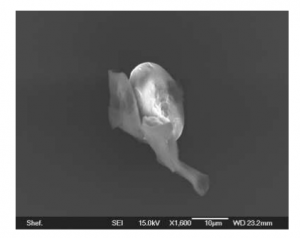
Biological entity (diatom-like = algae like) found on the sterile studs of a balloon sent over 25,000 m in the stratosphere
Biological entity (diatom-like = algae like) found on the sterile studs of a balloon sent over 25,000 m in the stratosphere Sheffield University/Journal of Cosmology


Sorin Adam Matei

Assistant Vice President for Partnerships in Strategic Defense Innnovation and Professor of Communication at Purdue University, Director of the FORCES initiative leads research teams that study the relationship between technological and social systems using big data, simulation, and mapping approaches. He published papers and articles in Journal of Communication, Communication Research, Information Society, National Interest, and Foreign Policy. He is the author or co-editor of several books. The most recent is Structural differentation in social media. He also co-edited Ethical Reasoning in Big Data,Transparency in social media and Roles, Trust, and Reputation in Social Media Knowledge Markets: Theory and Methods (Computational Social Sciences) , all three the product of the NSF funded KredibleNet project. Dr. Matei's teaching portfolio includes technology and strategy, online interaction, and digital media analytics classes. A former BBC World Service journalist, his contributions have been published in Esquire and several leading Romanian newspapers. In Romania, he is known for his books Boierii Mintii (The Mind Boyars), Idolii forului (Idols of the forum), and Idei de schimb (Spare ideas).

Leave a Reply

Your email address will not be published. Required fields are marked *