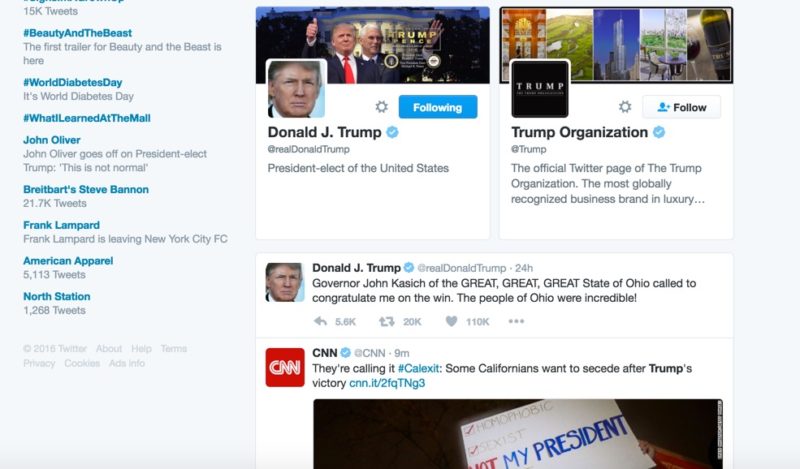
Donald Trump’s social media campaign is known for its virulence, but relatively less was said about its virality. Trump had a larger base of followers on Twitter. By the end of the campaign, he had 15 million followers to Hillary Clinton’s 11.1. This head start was there from the very beginning and has paid off handsomely.
What put Trump over the hill, as he, himself, suggested was the viral power of his message. His followers were more than consumers, they were also producers of his message. In social media playbook terms, they were true prosumers, customer evangelists.
According to my own calculations, between the beginning of March and just after election day, Donald Trump’s campaign tweets were marked as “favorite” 3 times more often than Hillary Clinton’s. More important, his tweets were retweeted more than twice as often, enhancing their chances to go viral.


The elections day performance on both dimensions was truly spectacular. Trump’s tweets were marked “favorite” and retweeted at 3.3 times higher rate than Hillary Clinton’s. Ironically, Clinton’s tweets exploded, too, but after the election. Between November 8-13, Hillary Clinton’s retweets finally overperformed Trumps by 1.6 times. What campaigning did not succeeded in doing, regret belatedly made up after the fact. Interestingly, Trump’s post-election Tweets continued to be favorited at a higher, yet more sedate pace.
Even more remarkably, none of the major negative events, especially the Hollywood Access tape that revealed his dangerous sexual proclivities impacted his Twitter impact. In fact, his counts went up immediately after the event, decreasing only after the third debate, which Hillary won. At the same time, the FBI inquiry announced just a few days before the election did not significantly impact either campaign.
As I showed in a previous post this summer, Donald Trump dominated in Google Trends, as well. The total volume of search for his name was twice as high as for Hillary Clinton’s over the same period.
Of course, the outcome of the election was by the end of the day decided by the voters, especially those from the key states of Michigan, Pennsylvania, and Wisconsin. Yet, if we consider that Donald Trump’s campaign cost half as much as Hillary Clinton’s, whatever he might’ve lost by not advertising as much on TV or by hiring local canvassers was probably made up in social media coverage.
If Barack Obama excelled at fundraising through social media, it might be said that Trump was quite good at mobilizing the people to spread the word about this cause.
In the coming days, I will continue the analysis with an in-depth look at the themes discussed in the tweets and their relative performance. I will distinguish between different types of rhetorical appeals and will evaluate their ability to mobilize the fan base.