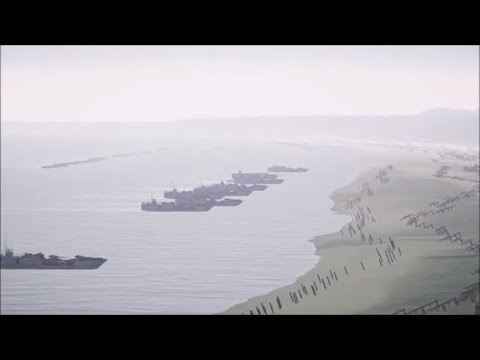
Virtual D-Day, the Battleflow Technologies immersive recreation of Omaha Beach also known as Virtual Omaha, launched on June 6 in Washington, DC. The date was more than ceremonial. D-Day is one of those historical moments that asks to be remembered not only through words and monuments, but through space: beach, bluff, obstacle, field of fire, distance, exposure, and time.
The project brings together military history, digital reconstruction, virtual reality, and teaching. Conceived by Dr. Sorin Adam Matei and developed through the Battleflow Tech Initiative with Purdue alumnus Matt Konkoly and collaborators including Drs. Jon Poggie and Robert Kirchubel, Virtual Omaha recreates the Normandy coast, the fortification, and the battles as they appeared in June 1944. Modern features are removed, wartime defenses and terrain are restored, and learners can see the invasion landscape from positions that are difficult to grasp from a conventional map or textbook.
Why Virtual D-Day Matters
Historical education often treats terrain as background. In military history, terrain is an actor. At Omaha Beach, the slope of the bluff, the visibility from German positions, the obstacles on the sand, the placement of weapons, the timing of landing craft, and the distance from waterline to cover shaped what happened. Virtual D-Day gives learners a way to stand inside that problem.
The value of the project is not merely the “wow” effect of virtual reality. It is the ability to convert historical reconstruction into an analytical experience. Students can ask why the landing was so costly, what defenders could see, why movement was difficult, and how command decisions were constrained by geography and uncertainty. The virtual environment makes the beach legible as a tactical and human space.
A June 6 Launch in Washington, DC
The June 6 launch in Washington, DC organized in collaboration with the Krach Institute for Tech Diplomacy and Purdue@DC placed the project in the right civic setting: a D-Day anniversary, a national audience, and a defense education context. It showed how digital humanities and military science can work together.
For Purdue, this is part of a larger effort to build tools that improve strategic thinking and historical understanding. The same initiative that develops models, data maps, and simulation tools also uses immersive media to teach. Virtual D-Day belongs in that family because it treats history as something to be explored with evidence, not simply consumed as commemoration.