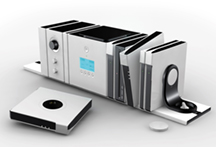
A piece of news I plucked from the Purdue News Service stream made my heart leap with joy. Two of my Purdue colleagues have won the Microsoft competition for designing the computer of the future. Their design slaughters the desktop computer to recreate from it a brave new world of smaller, tangible devices. A gesture of true grandeur. On a par with the deeds of the Summerian god Marduk who created the world from the dismembered body of his slaughtered mother Tiamat. (Sorry for getting carried away. The rhetoric needs to mesure up to the achievement .)
The new computing environment is made of discrete modules, which give each type of content not only individuality, but also physical body.
Now, if I scared you a little bit, that wasn’t unintentional. For some time I have been preaching to my graduate students and trying to convince some of my research partners in the industry that the future of computer is TANGIBILITY. That is, digital objects need to be enveloped and manipulated as much as possible via tangible representations and controls. The GUI, as Norman pointed a long time ago, is a transitional interface, which made sense as long as all we needed to control were a bunch of files stuffed in folders. When we start talking complex multimedia applications, which need fine tuning and careful meta-tagging, a better approach is needed. Following Norman, again, this should rely on invisible computing and information appliances.
New personal computer design wins Microsoft competition
One of the greatest concerns in the computer and digital industries today is copyright, Shim says. Studies show that consumers are more likely to disregard the ownership and copyright of digital contents because such files lack the physical properties of format media such as compact discs (CDs), laser discs (LDs) or digital video discs (DVDs).
A couple of other relevant links:
- Norman – Invisible
- Dourish – Where the action is