
- Graph illustrating Moore’s law Image via Wikipedia

Purdue researchers set foundations for next generation CPUS. Without smaller wires and transistors the triumphal march described by Moore’s law (computing power as measured by number of transistors per chip will double every 18 months) would have to reach a hard barrier by 2015. My colleagues at Purdue University are working hard at layering semiconducting materials a few atoms at a time. Chips could become not only more powerful but also incredibly small–microscopically small. Imagine not only nanocomputers, but nanobots, flowing through your veins to repair damaged tissue or to deliver focused chemotherapy.
A new generation of ultrasmall transistors and more powerful computer chips using tiny structures called semiconducting nanowires are closer to reality after a key discovery by researchers at IBM, Purdue University and the University of California at Los Angeles.
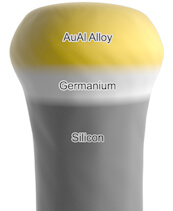
The researchers have learned how to create nanowires with layers of different materials that are sharply defined at the atomic level, which is a critical requirement for making efficient transistors out of the structures.
“Having sharply defined layers of materials enables you to improve and control the flow of electrons and to switch this flow on and off,” said Eric Stach, an associate professor of materials engineering at Purdue.
Electronic devices are often made of “heterostructures,” meaning they contain sharply defined layers of different semiconducting materials, such as silicon and germanium. Until now, however, researchers have been unable to produce nanowires with sharply defined silicon and germanium layers. Instead, this transition from one layer to the next has been too gradual for the devices to perform optimally as transistors.
Related articles by Zemanta
- Nanosensing Transistors Powered by Stress (technologyreview.com)
- After the Transistor, a Leap Into the Microcosm (nytimes.com)
- Penn study: Transforming nanowires into nano-tools using cation exchange reactions (scienceblog.com)
![Reblog this post [with Zemanta]](http://img.zemanta.com/reblog_e.png?x-id=abd3aa03-cd63-4f23-8119-f9f73781ad4f)