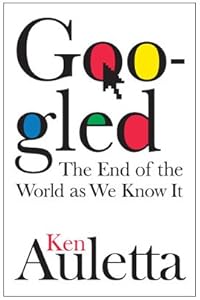
Sequel to two successful media epics, “Googled” delivers some major insights–the search giant might not be as strong as it seems–yet it does not raise above “competently executed.” Overall tastes like a reasonably well cooked dish following a well known recipe.
Ken Auletta’s main writing trick is to skillfully combine forgotten pieces of news, previously published books on the same topic (in this case John Batelle‘s excellent “The Search“), and behind the scenes details gleaned from personal interviews with the powerful of the day. It is a formula that worked well for Auletta’s Annals of Communications, a column he writes for the New Yorker and he saw no reason to change it for this book.
One of the other main strengths of the book is that it reminds us a thing or two that got lost during the roaring noughties. Google only invented one great thing: the search algorithm. Pay Per Click was pioneered by GoTo and Overture. YouTube was bought from its original creators (Chad Hurley, Steve Chen and Jawed Karim) and has yet to make money. Google Docs has not made much progress, at least on the user end, since it was bought from Writely. Google Voice is a version of Grand Central, sidewiki of Diigo and knol an also run to Wikipedia. Lively, already closed, tried to replicate the success of Second Life. Should it be any surprise that of Google’s 150 income streams adwords/sense programs deliver 98% of Google revenue?
Yet, what Googles does, does well. Its advertising income, estimated at over 20 billion dollars in 2008, mostly from text messages served with Google searches or syndicated through third party sites equals 2/3rds of the advertising income of all US newspapers. Although cruising, not soaring, Google has moved with the crest the tsunami of the 2008/09 crisis, instead of being washed away by it. Google’s stash of cash and global heft will help it weather the economic crisis and will give it a competitive advantage in a world of media weaklings. So much so that Google affords to pick up a fight with China.

The first section of “Googled” recounts the emergence of the search giant from the computer labs at Stanford onto the global scene. The story is well known and the details equally notorious. Yet, there is another, more fascinating story between the lines, which would’ve deserved a book of its own. It is the story of making a multinational corporation not by but with two twenty something graduate students. The story is not just about hard work, genius, or obsession. The story is (or should’ve been) about the seasoned men behind the scenes. Launching and sustaining a start up seems to be quite similar to spotting and making a mega music or movie star. In the digital world, just like in the entertainment business, individual qualities (smarts, pluck, or talent) matter, but it also matters who clothes you, introduces you to the right people, pays your first bills and then recruits new talent for your company. The central actors in the Google Saga are its board members, many of them old, seasoned hands, who ably and aptly played the Google card. Among them: Ram Shriram, Bill Campbell, Omid Kordestani, or John Doerr. (For more details about the executive team see the AOL Finance Page). Silicon Valley is just as much about who you know as Hollywood is.
The rest of the book seems to lack a clear direction. The problem is that Auletta had access to too much of the good stuff. Interviews with Mark Adriessen, Mark Zuckerberg, Mary Meeker, Mel Karamzin and with that most amazing of ad men, Irwin Gotlieb, come and go at a fast clip, deluging the reader with details. More significantly, the book veers off from the task at hand, which is to chronicle Google and its impact on the world, diverging into several mini essays about the future of media and advertising. This is where the routine of writing the Annals of Communication column for the New Yorker makes its effect felt the strongest. Auletta might answer to this kind of critique that the book is in fact about the world that surrounds us, of which Google is just a part. This might be true, but the story needs to be told in far more grandiose and ambitious way. A story that needed the Eye of God and a crystal ball. What the present book has to offer, that the efficiency and rationalization brought about the AdSense and AdWord has changed everything, is really not the answer. Both ad programs, successful as they might be, could pass as soon as they came. Google’s algorithms could be the victim of their success. They made possible an ecosystem of make believe business, companies, ads, and sites that create content to be ranked high by Google. They serve ads to be clicked by searchers lured by the fake content. When sufficiently capable companies will hit Google with sufficient computing power completely gaming the system the work it has created down on Google’s head, as a recent Wired Magazine on fake content warned us recently.
“Googled” does however a great job at characterizing the Google corporate culture and at capturing its main potential weakness. The success of its search technology was so absolute and profitable that Google did not need to think much about its future, priorities or canceling programs. Auletta reminds us repeatedly that Google makes over 90% of its money from Google Ads and Google Words. Google’s other 150 income streams, including YouTube, make little or no money. Referring to the unheard off policy of allowing its engineers to spend 20% of their time on projects of their own choice, Auletta asks: Is Google’s prosperity of product of its culture, or its culture of its prosperity? Google’s forays in mobile devices, like Nexus One, web OSes (Chrome), even energy production and healthcare record keeping, might be just as many white albatrosses, luring the company further and further away from its core competencies.
Sequel to two non-fiction epic accounts on the rise and downfall of American media–“Three Blind Mice” and “World War 3.0“– “Googled” inherits all virtues and vices that befall second and third acts in a writing career. Sparkles of insight are embedded in a relatively monotonous narrative. Formulaic and diffuse, the story seems to be the product of rewriting some of the insightful Annals of Communication columns Auletta has delivered with clockwork promptitude to the New Yorker for the past decade or so. Like all authors turned media celebrities, Ken Auletta’s own personality and name casts a long and heavy shadow over the book. Interviews with anybody and everybody who is somebody in the old and new media world are often, although not always, opportunities for schmoozing, not needling.
In brief, a great informational book, full of insight, which afforded to and did dispense with the finer points of writing.
Related articles by Zemanta
- YouTube Lost $200 Million Last Year, Profitability Will Come with Pay-Per-View, Ken Auletta (beet.tv)
- ‘You’re Fucking With The Magic’ (collaboratemarketing.com)
- The Bat Segundo Show: Ken Auletta (edrants.com)
- Week in review: China and Google, Facebook and privacy (venturebeat.com)
- Google AdWords Certification Program Now With Four Exams? (seroundtable.com)
![Reblog this post [with Zemanta]](http://img.zemanta.com/reblog_e.png?x-id=25f80ca2-d521-4803-ac6d-e8ee4077d2e3)