ResearchSocial Media

When do social groups reach critical mass?

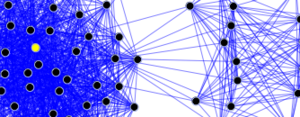
A segment of a social network
Image via Wikipedia

What is formula for calculating critical mass in social groups of smaller scales?

The problem of collective action is that each member of a group wants other members to make necessary sacrifices while he or she “free rides,” reaping the benefits of collective action without doing the work. Inevitably the end result is that no one does the work and the common interest is not realized. This book analyzes the social pressure whereby groups solve the problem of collective action. The authors break new ground in showing that the problem of collective action requires a model of group process and cannot be deduced from simple models of individual behavior. They employ formal mathematical models to emphasize the role of small subgroups of especially motivated individuals who form the “critical mass” that sets collective action in motion.

via The critical mass in collective … – Google Books.

Enhanced by Zemanta

Sorin Adam Matei

Assistant Vice President for Partnerships in Strategic Defense Innnovation and Professor of Communication at Purdue University, Director of the FORCES initiative leads research teams that study the relationship between technological and social systems using big data, simulation, and mapping approaches. He published papers and articles in Journal of Communication, Communication Research, Information Society, National Interest, and Foreign Policy. He is the author or co-editor of several books. The most recent is Structural differentation in social media. He also co-edited Ethical Reasoning in Big Data,Transparency in social media and Roles, Trust, and Reputation in Social Media Knowledge Markets: Theory and Methods (Computational Social Sciences) , all three the product of the NSF funded KredibleNet project. Dr. Matei's teaching portfolio includes technology and strategy, online interaction, and digital media analytics classes. A former BBC World Service journalist, his contributions have been published in Esquire and several leading Romanian newspapers. In Romania, he is known for his books Boierii Mintii (The Mind Boyars), Idolii forului (Idols of the forum), and Idei de schimb (Spare ideas).

Leave a Reply

Your email address will not be published. Required fields are marked *