A very interesting paper on calculating critical mass and predicting explosion of interaction on social media sites.
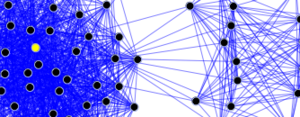
- Image via Wikipedia

Disagreement surrounds a formal definition of ‘critical mass’ and of the economic willingness to pay for membership in a social network. Our paper adapts work from percolation theory to analyze the structure of social networks, and draws an analogy for critical mass in social networks to the concept of phase changes in materials. We show how network growth can be actively managed, and define how to manage the willingness to pay for membership. We show, if achieving a critical mass of members in a social network is our objective, that prior to achieving critical mass, (1) the probability of accepting an invitation must vary inversely with individuals’ breadth of contacts; and (2) the number of special interest groups of any size will decrease following a power law until immediately below critical mass. Targeted invitations enabled through sophisticated programs such as AdWords and IndexTools can help to actively maximize the probability of forming an acquaintance link. Our model defines a willingness to pay for network membership that is nearly zero below critical mass, and is an involved function above critical mass whose shape appears to be close to a logarithmic function. Our robust measure of the connectedness of members of a particular social network yields values that are consistent with the independently developed metrics of Odlyzko and Tilly [Odlyzko, A., and Tilly, B. A refutation of Metcalfe’s Law and a better estimate for the value of networks and network interconnections, 2005 (downloaded from http://www.dtc.umn.edu/~odlyzko July 3, 2008)], and differ from eponymous ‘laws’ of Sarnoff, Metcalfe and Reed. There also appears to be plausible evidence in support of the market actually pricing networks at values close to Odlyzko and Tilly’s estimates.
Keywords: Network structure; Network demand; Critical mass; Phase change; Percolation theory; Sarnoff’s Law; Reed’s Law; Metcalfe’s Law
Related articles by Zemanta
- Social networks and chewing gum in your hair (webinknow.com)
- How Consumers Interact with Brands on Social Networks – eMarketer (emarketer.com)
- Google Researchers Exploring Social Networking, Possibly for Google Me? (mashable.com)
- Corporate Social Networking for Your Employees (eon.businesswire.com)
- When Will Shopping Become Truly Social? (ogilvypr.com)
- Why Hasn’t Location Reached the Mainstream Yet? (e1evation.com)
- Social Media Mondays: Six Strategies For Overcoming “Chicken And Egg” Problems (usabilitycounts.com)
