The Center for New Media and History at George Mason University announced last month the launch of a new Word Press extension, Anthologize, which will bring academic print and online publishing together. The idea is quite simple. Publish a book on your content management system, then print it out on paper. One of the bets made by the authors is that print books will not die that soon and that humanities scholars will prefer print versus pixel for their long narrative scholarship, especially books.
Our own project, Visible Past, which connects scholarship of several kinds to maps and print materials, completely embraces this idea and will promote anthologize as much as it can.
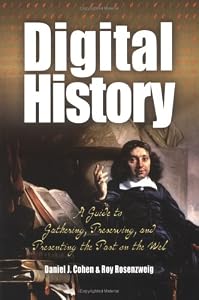
Since we are talking about digital humanities, a note about “Digital History,” a book authored by Daniel Cohen and Roy Rosenzweig a few years ago. It is a solidly researched and timely book about the need and tools available for a digital turn in humanities. (One of its authors is Dan Cohen, the head of the world famous Center for New Media and History also known as the driving force behind Zotero).
INTRO: This book provides a plainspoken and thorough introduction to the web for historians—teachers and students, archivists and museum curators, professors as well as amateur enthusiasts—who wish to produce online historical work, or to build upon and improve the projects they have already started in this important new medium. It begins with an overview of the different genres of history websites, surveying a range of digital history work that has been created since the beginning of the web. The book then takes the reader step-by-step through planning a project, understanding the technologies involved and how to choose the appropriate ones, designing a site that is both easy-to-use and scholarly, digitizing materials in a way that makes them web-friendly while preserving their historical integrity, and how to reach and respond to an intended audience effectively. It also explores the repercussions of copyright law and fair use for scholars in a digital age, and examines more cutting-edge web techniques involving interactivity, such as sites that use the medium to solicit and collect historical artifacts. Finally, the book provides basic guidance on insuring that the digital history the reader creates will not disappear in a few years.
via Digital History: A Guide to Gathering, Preserving, and Presenting the Past on the Web.
Related articles by Zemanta
- Create a digital history with History Pin (heyjude.wordpress.com)
- Historic collections meet the 21st century (boston.com)
- The Future of Social Media in Journalism (mashable.com)
- Richard J. Cox’s Archival Blog (readingarchives.blogspot.com)
- Digital Tech Brings History of India to Worldwide Audience (newswise.com)
- iPreserve Opens its Newest Franchise in Hillsboro, Oregon (prweb.com)
- Elive The Sounds of The Etruscans Through New Digital Technologies (socyberty.com)
- A New Kind of Web Publishing – Trailmeme Launches at DEMO Fall 2010 (prweb.com)
