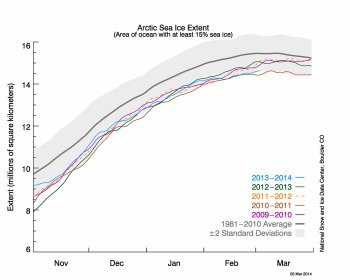
The extent of the ice cap in 2014 was not much larger than the mean for the last 30 years, despite a long, bitter winter in North America. Surface-wise was only 1 standard deviation under the mean for the past 30 years. However, it was at the upper end of the past 10 years and thicker than usual, which offsets the relatively small extent. One small silver lining, at “only” -25 degrees, the North Pole was “warmer” than usual by a few degrees….
While the eastern half of the United States has dealt with a cold and snowy winter, temperatures in the Arctic have been distinctly higher than average. The warm conditions have led to a slower than average expansion of the winter ice cover. Less ice also contributes to higher air temperatures by allowing transfer of heat from the relatively warmer ocean. The annual maximum in sea ice extent is expected to occur sometime this month.