NOTE: In some ways, I am a historian born again as a social scientist. A number of years ago in collaboration with Caius Dobrescu I published this article, which alongside my Romanian language book The Mind Boyars, is the fruit of my early historical studies. Above all, the article talks about my interest in the interdisciplinary study of communication, history, and ideas.
The Balkan people subjected to Ottoman occupation, especially the Romeioi Greeks, inheritors of the Roman empire and ruler of the East since Alexander the Great, had a hard time adapting to the new reality of being a subjected, second-class members of global Islamic politic. In response, they generated a gnostic mythology of long-term reversal or roles through suffering.
At the middle of the 16th century, the Ottoman Empire reached its zenith spanning three continents under the rule of its most famous Sultan, Suleiman the Magnificent (1520-1566). Only a few years before (1512) and after several decades of resistance and negotiations, the Romanian Principality of Moldova, a buffer state between the Ottomans, Poland, and Hungary finally accepted the Sultan as its sovereign lord (Georgescu, 1991). The process of submission was neither simple nor swift. ?tefan the Great was the first Moldovan ruler to pay tribute to the Turks in 1483, while his son Bogdan III officially and permanently submitted to the Sultan in 1512. This was not, however, the end of Moldova’s resistance to Turkish rules. Several wars of attrition under various princes stretched Moldova’s resistance to Ottoman dominance for a few more decades. One of the last episodes of active opposition took place under Prince Petru Rare? who occupied Moldova’s throne twice, between 1527-1538 and 1541-1546. Although officially an Ottoman vassal, Rare? opposed Ottoman expansionism by all means possible, from diplomacy to warfare. After losing a major battle in 1538 and three years of negotiations as a vagrant prince he bought his crown back from the Turks and became a much more, although not always, reliable ally of the Ottomans.
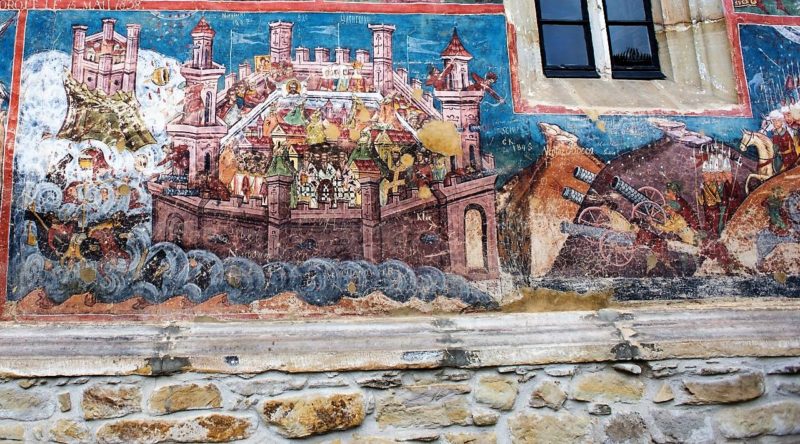
The contradictory spirit of Petru Rare?’s reigns is captured by the frescoes on the outer walls of several Moldavian monasteries (Probota, Moldovi?a, Humor) that the Moldavian Prince commissioned. The murals, which could be seen even by the occasional pilgrim, display a significant anachronism. They depict in great and vivid detail a rather obscure episode of Byzantine history. In 626 the Persians sieged both by land and by sea the Byzantine capital, Constantinople. The attackers were, however, rejected by Emperor Heraklius I (610-641) in a gigantic amphibious battle. At the time, the episode was interpreted as an example of divine intervention in human affairs. According to legend, Constantinople was saved by the intercession of the Virgin Mary, who showed her powers in the form of a storm that sunk the enemy fleet.
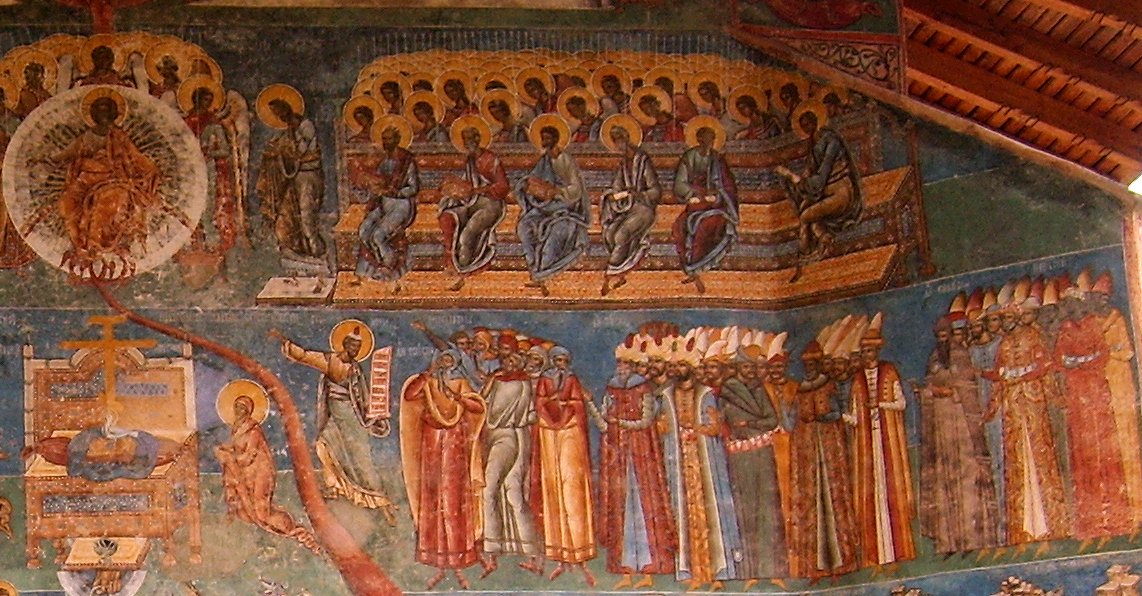
The Moldovan frescoes presented the protagonists in a different light. The attackers appear dressed in the garb and use weapons of a different battle, which took place under the same walls, but over 800 years later and with a different outcome. The besiegers wear turbans and fire cannons. These are the Ottomans who ultimately took Constantinople, putting an end to the Eastern Orthodox Christian Empire of Byzantium in 1453, just a few decades before the frescos were finished. The murals dramatically reinterpret the entire history of Eastern Orthodox Christianity, turning a recent defeat into a long past victory. Furthermore, other contemporary Moldovan church frescoes (e.g., Vorone?) show the recent conquerors of Constantinople at the head of a line of infidels who at Doomsday will be converted to Christianity by Moses himself.
The theological message of the Moldavian frescoes and their crusading mood seems totally misplaced given the political and military reality of the time. Are these messages, as some scholars suggest, of belligerence and active resistance? Are they signs of a resurgent crusading spirit in Moldova? While the answer could be “yes,” an important caveat is necessary. A 16th-century Russian theologian and traveler who lived for a while at Petru Rare?’s court, Ivan Peresvetov, assigns to the Moldavian prince the belief that the fall of Constantinople was not a sign of defeat, but one of salvation. The Russian traveler relates in a letter dedicated to Ivan the Terrible, the Russian Tsar, that Rare? believed that God himself delivered Constantinople to the Turks to teach Christians a lesson of humility. The Ottoman Sultan was in his view an instrument of Christian justice and redemption:
This is what Petru Rare? has to say about the Turkish Emperor, Mohammed: [After] the Greek [emperors and noblemen] scoffed at the Holy Cross, betrayed their people and robbed them by unjust judgments making themselves rich with treasures wrung from Christian tears and blood […] the infidel Sultan Mohamed knew God’s might [and restored justice], conquering Constantinople and restoring God-loved justice; he besotted God with his heartfelt deeds and God helped him take possession of many other realms.
Since Peresvetov’s opuscule is a political and moral tract belonging to the specula principum or Fürstenspiegel genre, whose goal is to instruct by parable, not by exact historical example, the words quoted above might, or might not, reflect Petru Rare?’s personal opinion. As an interpretation of Ottoman success, written at the middle of the 16th century after extensive travels throughout Eastern Europe, the book might yet very well reflect an opinion that was quite common at the Eastern Orthodox courts of that time. The Ottomans seemed, at their zenith, unstoppable. Even highly aggressive European military monarchies, such as Hungary, were wiped out by the Turks. What other power could guide their actions than Divine Providence? Rare?, the clerics who supervised the building of these monasteries, and the artists who painted their walls might have very well subscribed to the idea that Providence was sending Eastern Christianity a message. Given the aim of Peresvetov’s book to instruct the Russian Tsar and regenerate the defensive spirit of Eastern Christianity, which had sunken to its lowest point, the submission of Moldova and the defensive position of Eastern Christianity could have been interpreted very plausibly as a sign of divine intervention and even secret redemption.
According to Ciobanu, the anachronism found in the mural dedicated to the “pagan siege of Constantinople” could then be interpreted not as a celebration of anti-Turkish sentiment, but as a sign of God’s power to deliver his people even when they don’t deserve or recognize it. The Moldovan frescos and the manner in which they contradict political realities could be the earliest expression of an ideology of salvation in submission. This reflects, in our view, not only some important neo-Byzantine narrative strategies but also a Gnostic-like pattern of thought, which we propose as a possible source for that strand of modern Romanian national ideology according to which national submission and oppression is, in fact, a form of election.
The essay examines the master narrative strategy presiding over the early emergence of modernity in the area in which contemporary Romania is situated. This narrative strategy richly illustrates the neo-byzantine survival strategies of the Greek elites who ruled the Danubian Principalities (Moldova and Valahia) during the earlier stages of Romanian modernization (18th century). These elites brought with them a salvationist gnostic ideology honed during three centuries of subjection to Ottoman rule. Early modem Romanian political and intellectual elites borrowed from the post-Byzantine political theology a set of Gnostic-inflected narrative strategies to explain their subordination to alien powers (Turkish, Ottoman, Russian, Austrian, or Hungarian). These strategies operated a reversal of “real” and “unreal” or of “essential” and “fleeting” attributes of social-historical situations. The aim of these strategies was to construct the local elites as the agents of a political ideology of national redemption that will ultimately put them above their temporary masters….
[…]
Read the rest of the article
Citation and Download
Dobrescu, Caius and Matei, Sorin Adam (2011) “Latent Crusaders: Narrative Strategies of Survival in Early Modern Danubian Principalities, 1550-1750,” Journal of Global Initiatives: Policy, Pedagogy, Perspective: Vol. 6 : No. 2 , Article 3.
Also Available at: https://digitalcommons.kennesaw.edu/jgi/vol6/iss2/3