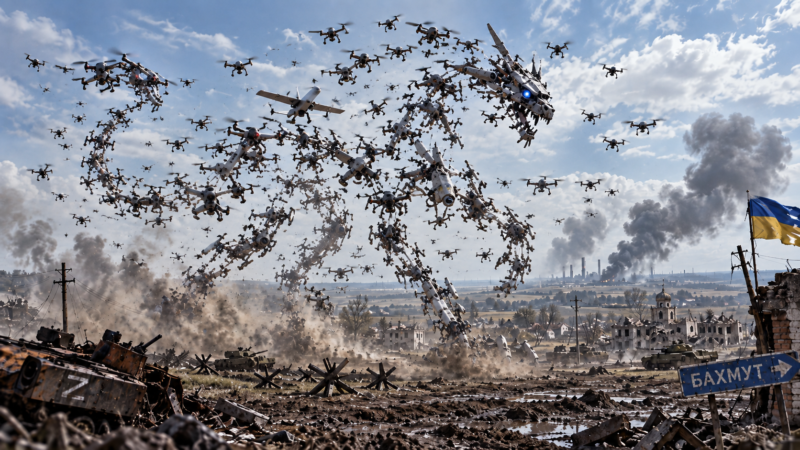
The future of drone warfare belongs to adaptive synthetic organisms, not flying flocks of kamikazes — swarms that can lose parts, reassign functions, and keep fighting, as living systems cannot.
The future of drone warfare will not belong to the side that can merely launch the most machines. It will belong to the side that can assemble the most adaptable machine organisms. The idea is to organize the swarms, not the machines themselves, as organisms.
Much of the current discussion about drone war begins and ends with arithmetic. Analysts imagine ever-larger swarms of cheap, flying munitions blotting out the sky and saturating defenses by sheer numbers alone. Quantity matters, of course, because mass has its own logic. But this vision makes the old mistake of linear interpolation: it takes today’s loitering munition, multiplies it by a thousand, and calls the result the future. That is not foresight; it is photocopying.
The error goes beyond bean-counting. It assumes drones are essentially single-purpose objects: airborne delivery systems for explosives, useful mainly because they are plentiful, expendable, and precise enough. On this account, the swarm is just a buzzing cloud of dumb but stinging bees. Each unit is a near-identical creature. They are drones in the literal sense of the word. Military advantage comes from adding more drones. The swarm overwhelms just as a flood drowns.
Yet, this logic is too simplistic. Real drone warfare is already more interesting than that. Even now, operations in Ukraine, Iran, or Gaza tend to depend on combinations of platforms and functions: some systems scout, some relay communications, some jam, some deceive, some strike, some assess damage, some map routes, some hunt emitters, some simply extend the awareness of the others. The relevant metaphor is not a cloud of identical insects but of a well-integrated body. Modern drone warfare increasingly resembles a set of specialized organs acting in concert, each amplifying the rest and all controlled by both a sympathetic (conscious) and parasympathetic (unconscious) nervous system.
The future belongs not to literal swarms but to protean, organic multicellular beings, each drone performing a specific role. Even more advanced that biological bodies, drone organisms will be able to shape shift because their cells could take various missions, on demand or in context. Drones will create shifting architectures in which they are defined less by permanent role than by temporary function. A drone will not be important for its shape or capabilities, but for the roles it can assume within the larger whole at the moment. Some may be physically similar or rely on identical platforms. Yet software, payload, networking, sensing, and onboard computation will enable a single vehicle to become many things. The analogy is not merely to the smartphone, but to the software-defined radio: the same hardware can become radically different tools depending on how it is configured and connected by code. This agentic AI at the physical layer.
This matters because war punishes rigid systems. A swarm composed of fixed roles is brutally effective, but brittle. A swarm whose members can change roles under pressure is something else entirely. Imagine a formation in which a handful of drones act as forward sensors, others as munitions carriers, others as decoys, others as airborne processors handling edge computation, target recognition, navigation, and task allocation. Now imagine that attrition knocks out the “thinking” drones. In a primitive swarm, the formation simply gets dumber. In a protean swarm, some surviving drones surrender primary functions, absorb new software tasks, redistribute compute loads, and become the swarm’s replacement neurons. Capability degrades, but it does not collapse.
That is the real revolution: not size alone, but plasticity. The most formidable swarm will be the one that can thicken or thin, simplify or elaborate, depending on the mission and losses. In one environment, it may behave like a reconnaissance web, stretching wide, sensing lightly, and avoiding detection. In another, it may condense into a hard striking fist. In yet another, it may become a moving electronic-warfare screen, with decoys on the edges, relays above, strike assets tucked behind. Complexity itself becomes scalable. The swarm can grow organs when it needs them and shed them when it does not. Drone swarm, thy name is Chimera.
Such swarms will not be confined to the air. The truly formidable architecture will be cross-domain. Aerial drones will work with land robots, amphibious systems, static sensors, climbing machines, communications nodes, and perhaps disposable micro-devices scattered across terrain like seed. The old picture of the drone as a flying bomb will look, in retrospect, as crude as imagining a computer as a typewriter with electricity.
A note of caution. The biological analogy, rightly used, alludes to creatures that only science fiction writers imagined. The future swarm will be an organism more complex than any created by natural biology. It will be layered, distributed, semi-specialized, yet still capable of compensation when damaged. The “eyes” may be lost and replaced by other sensors. The “skin” may be punctured and reconstituted by new screening behavior. The “brain” may be decentralized, with cognition spread across many nodes rather than housed in a single, vulnerable headquarters. The “teeth” may stay dormant until the rest of the organism has prepared for the strike.
This will also make such swarms harder to defeat than the popular imagination allows. Defenses built around destroying mass may instead find themselves facing reorganization. Defenses built around decapitation may discover that there is no single head to cut off. Defenses built around jamming one function may watch the swarm reroute another. The enemy will not be engaging a flock. He will be a “fighting metabolism.”
There is, to be sure, a danger in over-romanticizing autonomy. War remains constrained by bandwidth, energy, weather, terrain, cost, doctrine, and the grim friction of loss and chance. Not every drone will become a universal machine. Hardware still matters, and payload limits. Some tasks will require specialized airframes. But none of that weakens the larger point. The decisive trend is to veer away from simple accumulation and toward adaptive composition. The swarm of the future will not merely be bigger. It will be more varied, more fluid, and more able to reassign meaning to each of its parts.
That is why the coming age of drone warfare should be understood in organismic terms. The best swarms will be those that can survive damage, and trade redundancy for specialization, depending on what the moment demands. They will not win because they have the most bodies in the sky but because they can turn bodies into functions and functions back into bodies.
The ultimate military swarm, then, will be something new under the sun: not a machine in the old sense, and not alive in the biological one, but a form of synthetic life, nonetheless. A future organismic swarm will not fight like a rainstorm of metal. It will fight like Hydra, the creature whose heads cut off by Hercules kept growing back, and look like its sibling, Chimera, the creature with a lion’s head, goat body, and snake tail . In that sense, the final form of the drone swarm is not the cloud, but life’s highest trick— to remain one thing by becoming many others.