The ancient Roman general and Consul Cincinnatus lived, as Livy tells the story, with one hand on the sword and the other on the plowshares. Living centuries before the decline of the Empire, when military men became dictators, and the legions were as likely to pillage their own provinces as those of Rome’s enemies, Cincinnatus was the prototypical citizen-soldier. Although ruined by politics, he did not hesitate to put aside his personal business when the Republic needed his services. Acting as supreme leader for 16 days, he defeated the enemies of Rome only to return to his modest farm. The early American colonists, the Minutemen, saw themselves as his inheritors. Today working the fields, tomorrow picking up the musket to chase the Brits out of Lexington. As banal as the name of the city Cincinnati sounds today, it was not called that for nothing. It was a way to keep this tradition alive.
The American military of the 21st century is a professional, all-volunteer army. It trains men and women to live and work by a code of honor and professional excellence, doubled but not supplanted by civic duty. But even if their jobs differ from those of ancient warriors or our colonial ancestors, our military compatriots are citizens, mothers, fathers, students, and, at some point, senior citizens deserving our respect. I was reminded of this simple truth at a cafeteria table, speaking with a sergeant at a military base in Nevada that hosts one of the most advanced and lethal Air Force units in the United States, an MQ-9 “Reaper” Drone Squadron.
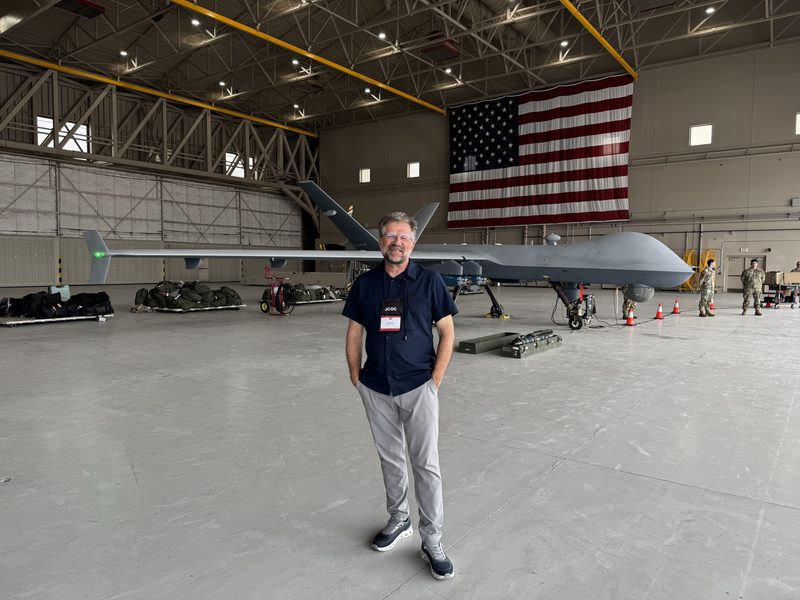
The sergeant was young, maybe too young for my aging eyes. Perfect hair, well-combed, maybe too well-combed, healthy white teeth, a winning but at times demure smile. Professional answers flowed to all my questions about training (“was it difficult?”, “not if you like it”), about work (“is it tiring?”, “at times”), about life in the desert (“is it hot?”, “what do you think?”). We bantered a bit more about the dust and heat, but the discussion was mostly about being responsible for multimillion-dollar devices the sergeant’s team controls via a mind-boggling network of wires and waves on the other side of the planet, several time zones away.
The job is indeed taxing. Just like any long-haul pilot, drone operators spend long hours in the chair, flying, controlling, and firing the drones’ weapons. Occasionally, the drones disappear and burn, taking with them the pilots’ pride and, for a short time, their confidence. The pilots probably mourn the drones the same way Cincinnatus mourned after his horses were killed under him by the raiding barbarians. Only here, our warriors live in the desert, not in green pastures, and protect the air, not the fields.
The non-commissioned officer I am talking to has been in service only a few short years. Training, more training, work, more work. It could be (it is!) taxing. The word returns to the conversation. It is the difficulty that makes the work interesting, though. It is very high-level structured work.
Each drone has a pilot and a sensor officer. Their controls are complex and decisions many. They sit side by side for all those long hours of service. While this can forge bonds, it can also lead to frayed nerves. There are also the long intervals between the “hot” sequences of a mission. Boredom needs to be broken by going over routines again and again. Although the mission is “virtual,” it is not a video game. It happens in real time. You are responsible for a very heavy plane, as large as an A-10 Warthog, flying very high, at times in bad weather. You cannot sleep on the job or even go to the restroom without a replacement.
But there are perks, the sergeant tells me. At the end of the day, you go home, cook dinner, eat, study a bit for your next degree (a BA, BS, or maybe even an MS), watch a bit of TV, and then sleep in your own bed. You wake up in the morning, commute for 30–40 minutes, and start again. Sure, life in the desert is not the most comfortable, and housing is not the most affordable, but it is an immensely satisfying job.
And then, there is the advantage of being next to one’s family. The sergeant finally cracked a smile when she mentioned her kids, one a toddler and the other in elementary school. Shortly after that, she excused herself, heading to her car to go pick them up from school.
- Live in the Desert, Fight in the Air: What I Learned from a Nevada Cincinnatus
- When All Fails, Hit the Bone: What I Learned from the Military Doctors
- Found in the Fog of Combat: Confusion is in the eye of the beholder
- Do Look Down! What I learned from the Marines
- Transforming Warfighting: The Case for AI and Software-Centric Strategies
- What is a strategic technology?
- What should a strategist know? A competency-based education program for strategic thinkers and doers
- Can international trade instigate the next great conflict?