I am not a squeamish man. I do not like seeing blood, but it does not scare me. My grandmother, born in 1900, kept chickens, pigs, sheep, a goat or two, cattle, dogs, and assorted cats. I saw my share of slaughtered animals, either by my grandparents or by their dogs and cats. I killed a few chickens myself using a rusty knife. It was where food came from. From my grandparents, I learned that some decisions require hard but efficient ways of dealing with the realities of life. The military doctors of the US Army and Air Force recently reminded me that this is not just a vague, wise saying but a very useful management practice. The doctors, especially military ones, can teach us a thing or two about dealing with edge cases in our organizations.
When they brought that young man into the field hospital with his shirt soaking with fake blood, I wasn’t much impressed. It was the combat exercise organized by the 7th Infantry Division for the Joint Civilian Orientation Conference, where I was one of 40 invited U.S. civilian leaders. We were exposed to a variety of simulated combat situations, including the vital need to treat the wounded as soon as possible and to evacuate them. Spicing the situation with some blood, even if of the movie kind, was expected.
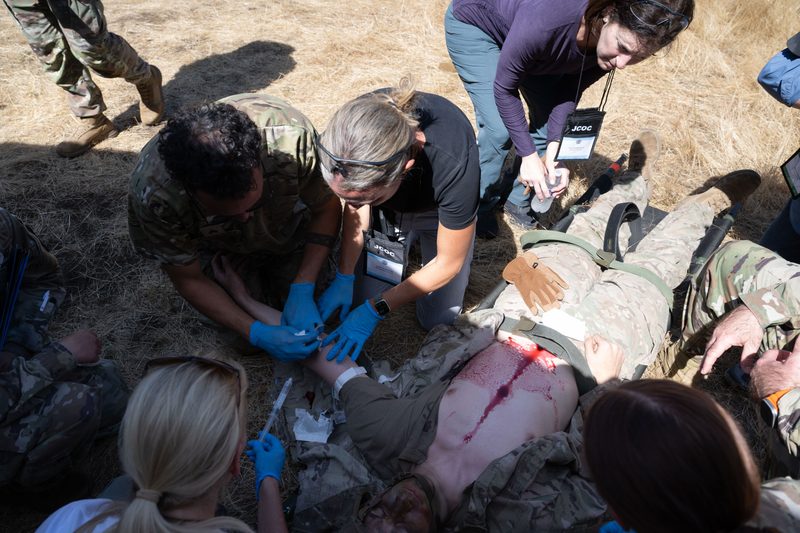
The simulation included field triage, treatment, and dressing of two “wounded” American riflemen. The one I hovered around as a participant observer had an abdominal wound that was supposed to bleed profusely. A generous amount of sticky blood-like fluid was pooled in his navel. He was adequately quiet and limp. We ripped his shirt and cleaned the blood that had already trickled into his pants. Ouch. After a thorough cleaning, we inserted an IV. I had the honor of sealing the catheter once it was put in place. A nice little film that stuck like skin at the crook of his arm.
The medical team did its job expertly fast while explaining to us civilians what was going on. Mostly routine stuff, such as stabilizing, cleaning, and packing the patient for transfer to higher-echelon care stations. As I said, I was not much impressed. My wife, the physician of the family who deals with hard cancer cases every day, calls me the “nurse” for my habit of cleaning, sprinkling, applying Bacitracin, and dressing the minor and major scrapes of my children. It is part care and part genuine curiosity as to how the body responds to medical care. I think that I would’ve made a decent nurse, if not a primary care physician, in some Romanian village if I had not chosen the academic path. I might’ve also raised pigs and chickens and occasionally participated in the seamier aspects of country life.
Yet the true importance and core principle of military care, I only comprehended a few days later at another field exercise at the Micke O’Callahan Medical Center, just outside Las Vegas at Nellis Air Force Base. This is home of the Air Force Warfare School (think Top Gun with real pilots). The thousand-square-mile testing range includes Area 51 (wink, wink!). Less known and most importantly, at Nellis, the U.S. hosts one of the best military medical centers that specializes in level 3 trauma: major burns, head, heart, anything that may kill you before you realize it. Even less well known is that the center devotes a significant portion of its work to treating gravely ill civilian patients. It is recognized by the American Heart Association as a national leader in urgent care for heart attacks and stroke. As someone joked, there is no better way to have a heart attack than in Las Vegas. Or likely.
All the medical personnel at the medical center rotate on deployments. They see more specialized trauma cases than most American doctors.
And this is what they taught me: when all fails, hit the bone!
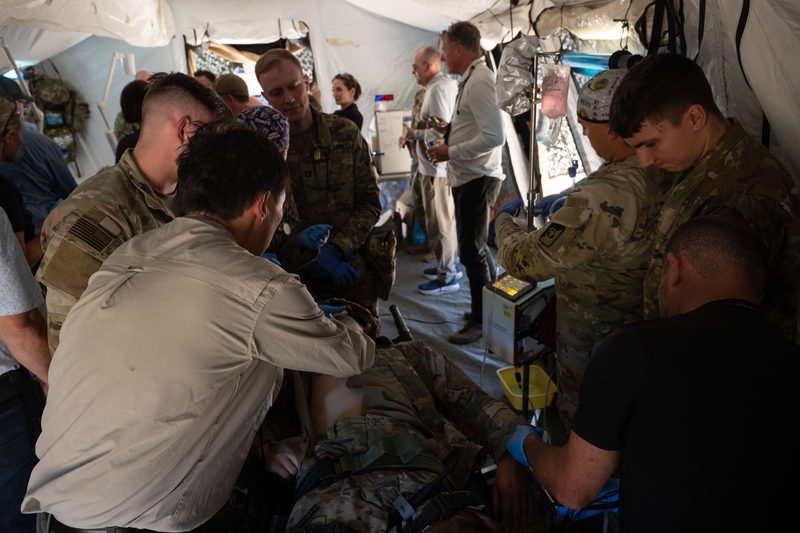
Patients in traumatic shock typically lose a lot of blood and with it, arterial pressure. Their veins turn into flabby, slippery ribbons of flesh. Transfusion needles pierce them rather than being inserted lengthwise to deliver blood or plasma. The is now in danger of final collapse and death.
When things get this desperate, it is time to think a very different way about blood loss. Replenishing the fluid of life demands going to its source. A dramatic and radical measure is needed. It is time to do a bone transfusion.
Those of us who slaughtered animals or dug a cemetery as part of an archeological excavation (I have to confess, I did that, too, in college) will remember that the large femur (thigh) or humerus (upper arm) bones are porous. Their inside is crisscrossed by a warren of comb-like cells, not as regular, but as airy and fine. When alive, those bone structures contain marrow, a fatty, richly vascularized substance. The marrow is not just a fat reserve; it is the stuff the body uses to make blood. The blood vessels that supply or drain the marrow enter the bone through several openings called foramina situated in the middle of the bone shaft. Our bones are organs fed by blood, just like any other. Because the interior of the bone can withstand some pressure to force blood into the vessels, when the patient’s blood pressure drops dramatically, it is time to take advantage of this unique feature of mammalian physiology to reirrigate the body with blood.
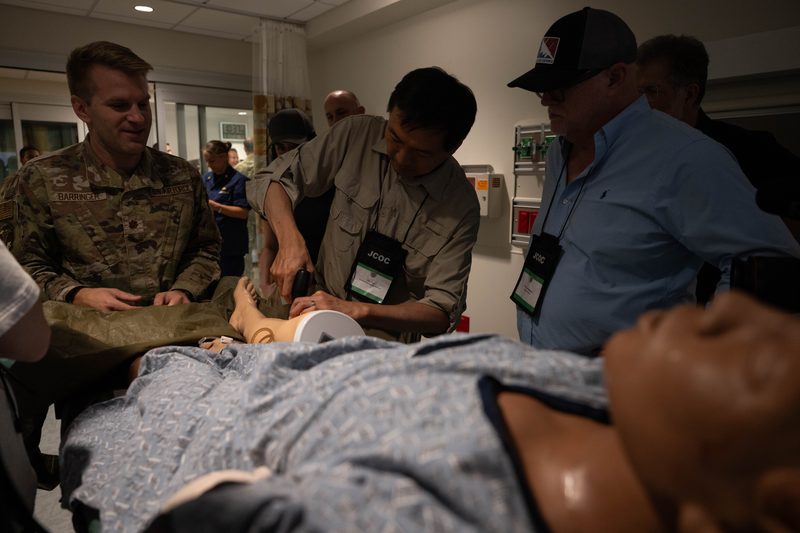
It is an apparently brutal procedure to pierce the bone to create a catheter head that would pump blood back into the body. First of all, it takes a bit of force and a nasty sound. The bone should be hit where it is largest. To force the needle in, you need a drill. Two locations are preferred for drilling the bone: the shin, about three to four inches under the knee, and the shoulder. The drill will go zoom and pop right into the thickest part of the shin. Like a soccer kick only harder, the doctor who had this done on himself says. When hitting the shoulder, the rotating needle would penetrate through skin, fat, muscle, the head of the bone, all the way to the marrow. Once inserted, the needle is retracted, and a soft catheter is left in place to pump the blood. Some pressure is applied; the doctors used the term “explode the bone.” The pressure destroys some of the internal comb-like structures, allowing a generous amount of blood to be pushed out of the bone.
So, what I learned from the military physicians? The most extreme situations demand more than compassion. They demand what I called, in a paper on strategic thinking, “indirect” or, in this case, “crookedly efficient” thinking. You need to think about the essential, in this case saving a life, using subterfuges, in this case delivering blood where we usually fear reaching, and force, in this case piercing and exploding the bone.
Military doctors are awesome. Their procedures, also practiced for some time, are not widely known to us laypeople because they involve the extremes of life-and-death decisions. Civilian leaders should be equally awesome, seeking, in the most extreme situations, the most extreme, courageous, yet inventive solutions. Lateral, unconventional, forceful measures are sometimes needed to deal with the curveballs of organizational life.
- Live in the Desert, Fight in the Air: What I Learned from a Nevada Cincinnatus
- When All Fails, Hit the Bone: What I Learned from the Military Doctors
- Found in the Fog of Combat: Confusion is in the eye of the beholder
- Do Look Down! What I learned from the Marines
- Transforming Warfighting: The Case for AI and Software-Centric Strategies
- What is a strategic technology?
- What should a strategist know? A competency-based education program for strategic thinkers and doers
- Can international trade instigate the next great conflict?