The mission was simple; the fighters were not, and their understanding of what they were doing was even poorer. Yet they did their job BECAUSE of the chaos surrounding them. This is what they learned and will apply in their future civilian careers: the fog of war can be their friend if…
This was a simulation mission, an exercise. The platoon members were participants in the Secretary of War’s Joint Civilian Conference week-long trip throughout the Western United States. They were a mixed, but interesting group of people. CEOs running billion-dollar companies. Hollywood movie and media producers, some of them running YouTube channels with hundreds (!) of millions of viewers, others responsible for hits such as superhero movies. One was a gym buddy of Arnie’s (that Arnie!) and a dedicated organizer for veterans services. There were also several academics with hundreds of papers and, in my case, a bad case of sedentarism and reading rather than participating in military affairs. One of the participants had a mesmerizing hobby. He was a mentalist magician, expert at card, mind, and even phone-password reading (beware!). Another ran a large agribusiness that uses computer vision the military can only dream of to blow individual bad grains as they fall in the production process. She is also a mom of three kids, one of whom is very, very young. There was also the food production manager responsible for what your kids had for breakfast, and two VPs of the competing car racing organizations we all know and admire.
The goal of the conference was to offer them a hands-on, firsthand insight into the practices of the American military. At a training base in Washington State, we trained with the 7th Infantry Division. A platoon-sized unit was sent to evacuate a couple of wounded soldiers.
We did not know each other and did not care much about each other’s business before this trip. Yet here we were, fighting in the fog of war. Despite minimal training, we did what we were told, and somehow things turned out well. But how?
First, we shook away prejudices about combat. It was immediately evident that it is not a story of courage alone. It was also not simple at all. What on paper looked like a walk in the park for the individual fighter was an existential fight as big and as scary as any battle from Kadesh and Marathon onward. Reports and cinematic reflections of “small firefights” or “minor engagement” do not do any justice to what is typically called “the fog of war” or the chaotic nature of war. However, what I learned from experiencing only a simulated version of war chaos is that combat is both entropic and orderly if the man or woman engaged in the fight does what they are told to do, allows training to override their emotions, and approaches the process with trust in the system. The job of an ordinary soldier is, in many instances, much simpler and direct, even if everything around him or her constantly falls apart and he or she has to pick it up again. Their job is to refuse to see the chaos. Sticking to their immediate mission, she and he should trust the rest of the fighting unit and the orders they were given. Furthermore, in fog you may hide to strike even harder if you know what you are doing.
But what is this fog of war all about, really? In our case, it was a smelly, hot, and noisy corner of a minor hell. It might’ve very well been a cold, or wet, or balmy day; hell, it would’ve been nevertheless. The staccato of the rifles interrupted but not silenced by overlapping coughs of the heavy machine guns made sent vibrations through the air, guts and your lungs, shaking your brain.
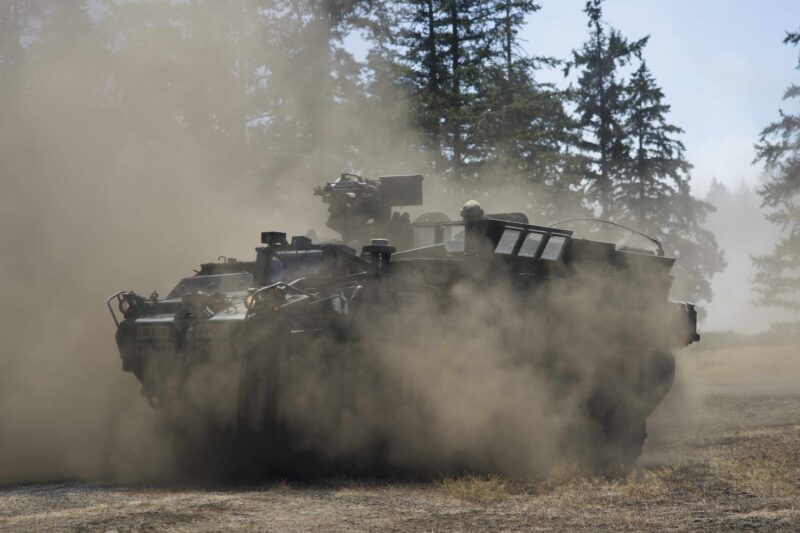
But you had a job to do. So, you put aside what your senses told you and got on with the mission, following the squad leader. The job was to save a wounded comrade fallen in the middle of a nasty firefight. A platoon, including you, mounted on Strykers, was sent in to take care of business. Inside eight-wheel armored fighting vehicles carrying even meaner 30 mm automatic cannons, anti-tank missiles, or heavy 50-cal machine guns, we were deployed to protect and execute the evacuation. 40 men and women loaded onto vehicles, up to 5 in each, went in at speed, dust penetrating the vehicles, powdering the black paint of the guns. Rushed out the back doors and deployed in a skirmish line, we executed a blocking fire mission at the edge of the battlefield. A few of us went in under the cover of the fire executed by their teammates, retrieving the wounded soldier and then withdrawing in order.
As simple as it sounds, for the fighters this was an exercise and sensory overstimulation, the extreme opposite of sensory deprivation. Furthermore, the mission was explained in the vaguest terms. The order that stuck with me was “do what the squad leaders tell you.”
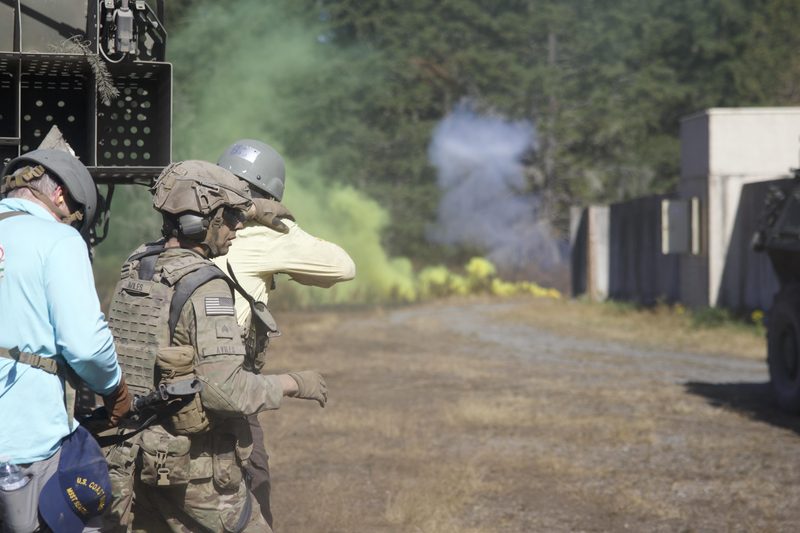
A nasty-looking sulfurous yellow smoke covered the battlefield. The thick, acrid smoke from the grenades we kept throwing to hide our movements was everywhere, enveloping the senses as it wafted psychedelically over a rock-and-roll concert stage. One of the oldest war instruments, smoke created on purpose to hide attackers or defenders from the enemy, encapsulated the essence of war, both literally and philosophically. People do not fight with clear eyes, minds, or understanding of what they are doing. They grope in the dark for their enemy. How can anything be achieved in this valley of the lost, in this mist of the dead?
“Follow the squad leader!” Which I did. Kneeling, with the squad leader to my right and two over-age recruits to the left, all we saw was a tree line coming in out of the smoke. We were given specific fire sectors. Two black-clad insurgents popped their heads occasionally from the bushes. I started firing in a tap-tap manner, as I remembered from my previous military service with a Romanian artillery regiment 40 years ago, where I served as a forward observer.
Different rifle, same idea. Whack-a-mole. Tap-tap. Tap-tap. Tap-tap. After a while, the black marionettes lost their strings and fell to the ground. “Good job,” exclaimed the squad leader, slapping me on the back. He rushed me back to the Stryker, ordering twice to turn and fire from a kneeling position in a staggered manner, covering each other.
“What did we just do?” I asked myself once the monstrous machine closed the back hatch and started the roaring engine. I simply shot my rifle in small, methodical bursts. It was nothing like other similar situations. I remember the heavy, buzzing bumblebee sound of the 7.62 AK-47 bullets flying by my ears and landing with a smack in the soft ground during the 1989 Romanian anti-Communist revolution. Yet, even without the “luxury” of being shot at, which would’ve enhanced the feeling of liberation by following simple orders and firing back, it was very satisfying. I suddenly saw how my small actions, chained to those of my squad comrades, had a cumulative effect. Tolstoy, the author of the legendary War and Peace, once said that the flow of war can only be seen if you think about it as a form of calculus. Its curve of ascending violence, culminating fire exchange, and the abrupt slope of conclusion look very different when you observe it up close and then again from afar. At the ground level, war is a seemingly chaotic chain of discrete events. This fellow kneels shooting aimlessly. That one, prone, shoots methodically. A third turns back and hides under a rock, opens a packet of jerky and starts munching nervously. A fourth woman makes angry gestures at her closest comrade, who shoots away, leaving a gap between them. However, if we subtract what they do from what they were supposed to do, an act which in calculus we call “derivation,” we obtain a series of values representing how well each of them fit the curve of the mission. If the distance is tolerable, the mission was accomplished; the curve took shape.
The secret of working together in highly stressful situations that demand quick and decisive action is not to try to make sense of the whole, but to trust that the mission was well designed and to follow your local leader the best you can. Everything else will take care of itself if the distance between what you were told to do and what you did is within parameters. Most importantly, you do not need to understand the whole, or even the whole does not need to understand itself. What matters is hiding and taming the chaos, and making it your superpower by developing and following simple local rules.