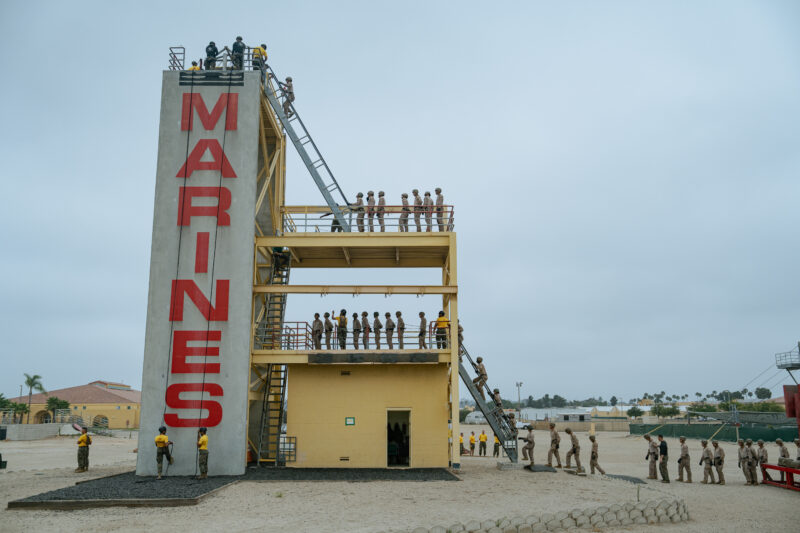
In the sixty-first year of my life, I was looking down into an abyss. Not of the existential kind. It was a very physical 60-foot drop into the well of the Marine Corps rappelling tower at the Marin Corps Recruit Depot, used to certify its recruits. I was about to make one of the most incongruous decisions of my life: an academic playing Spider-Man.
But how did I get to this decision-making point, and what was I expecting to get out of it? As a participant in the Joint Civilian Orientation Conference 2026, the Secretary of War’s annual outreach event for civilian leaders, I had the chance to see how the United States’ defenders ply their craft. The mission was to learn about the Department of War’s mission and, based on our understanding of what we saw, spread the word, discuss, or reflect on it.
The focus was on people and experiences. We discussed bigger-picture issues, absorbed as many numbers as we could, and puzzled over organizational charts with as many dependencies as grapes in a bunch. For me, the Department of War message was complemented by something I did not expect: I discovered principles for personal and professional life that I could use to better understand and improve myself, my colleagues, and our civilian life. Although there was much to absorb in the five short days of the experience, which started at 5 am with military precision and ended late in the night sorting out the avalanche of experiences, after I let it all seep through, seven lessons, each driven by an unmistakable principle, revealed themselves like old-fashioned pictures emerging in the developing fluid of memory. These are:
- do look down,
- live in the desert, fight in the air
- found in the fog
- when all fails hit the bone
- the mind – body problem does not exist
- space starts at the horizon
- separate the lanes and
- you can make a team out of anything
But let us return to the Marine Corps tower and my fateful decision. During the last day of our military tour, we were quickly and surprisingly herded to a training facility wedged between the beautiful beaches of San Diego and the Airport. A tall, hollow structure, faced by two solid walls and supported by an industrial beam scaffold in between, climbable by a series of steep ladders, bore a huge, red-lettered inscription: Marines. I found myself at the top of this contraption in no time, strapped in an improvised harness made of a length of rope, with a helmet on my head that made me look like a dopey Smurf. A 20-year-old Marine who could’ve been my grandson looked me in the eye and, in a voice that reminded me of the nurse who gave me the first dose of vaccination, told me softly: “Sir, follow my directions; it will be fine.” Although I was trying to appear tough, speaking in one-word sentences, “Here?”, “This?”, “Fine,” he saw through it all, the anxiety, remorse, and lack of confidence he should’ve seen in hundreds of other recruits taking the rappelling test.
This is not a complicated business. You are supposed to step over the edge of a hatch in the floor of the platform at the top of the building, about six floors above the ground, and while holding onto the rope with your left hand, use the right one to control its slide through a carabiner fastened to the harness coiled form on length of rope around the buttocks and the groin. (This tie-up made us men look like Henry VIII in one of his famous paintings featuring more of his codpiece than his chest. But I digress.)
Rappelling is not a test of physical skill. Although Marines might occasionally have to scale and descend a building’s walls during urban assault, they do not climb mountains. They are sea people. After I finished my evolution (more in a second), I asked why the Marine Corps included this in their training. I was told that this is a “finishing” test that is taken at the end of boot camp, just one short week before graduation. Its goal is…
Let us now return to the scene where I am being psychologically prepared by my grandson to take action on something I otherwise would’ve called the stupidest thing a senior university administrator, short of telling the faculty “No!,” could do. That kid knew people. Not only did he use his voice, but he also made me hold his gaze with a mix of certainty and professional knowledge. Within a couple of seconds, he made me believe that what would follow was simple and necessary. But most importantly, he helped me, in a most unexpected way, breathe out all my anxiety with two simple pieces of advice, the first of which, “do look down,” was the most important. The second was “control the fall.” There was a third one, which he did not spell out in words, but I derived from this necessary ordeal: “trust the system.”
Allow me to expand, because each of these principles is not hollow words to soothe the anxious. They are, in fact, among the most insightful recommendations I received before making a life-altering decision, professional or personal.
“Do look down.” By saying this, the young Marine NCO helped control the situation in two different ways. First, although it went against human instinct to avoid looking down when on a precipice, his advice was practical and efficient. To manage my human fear of height, I needed what the military calls “situational awareness.” How far was I from the ground? How far was I sliding? How well did I control the rope by looking at it dangling beneath me? How and when should I break by using my right hand to bring the rope sliding out of it closer to the body?
Second, and most importantly, looking down turned the distance between me and the ground from a terrifying abyss that might’ve eaten me alive like the Sarlacc in the Pit of Karkun of Star Wars fame, where Luke fights Jabba’s sand pirates, to a workspace like any other, with a predictable length and a method of approaching. It turned the height into something as easy to handle as the equivalent distance might have been if I were to jog it.
Third, NCO’s explanations, his method of calming my nerves, the regular procedure I learned in a few short minutes, and the clearly predictable outcome I could see from following orders built an unshakeable trust in the system instantaneously. I trusted myself, my understanding of the situation, the NCO, the rope, the tower, and ultimately the Marine Corps.
This final test was meant, for the countless Marine recruits who preceded and followed me, as a test of belonging. It worked on both the mind and the body, turning a hesitant, doubtful human being into a trusted, mission-focused, brave-with-a-reason team member. You (I?) are now Marines. Oo-rah.
Read the other essays in this series on military leadership principles that I found useful for civilian organizations through my participation in the Joint Civilian Orientation Conference.
- Ask Not “Who,” but “What” Is Vandenberg: Space Starts at the Horizon
- The Military as a “Civilization”: How to Make a Team from Anything
- The Mind – Body Problem Does Not Exist: What I Learned from the SEALs
- Separating the Lanes: What Does the Coast Guard Do?
- Live in the Desert, Fight in the Air: What I Learned from a Nevada Cincinnatus
- When All Fails, Hit the Bone: What I Learned from the Military Doctors
- Found in the Fog of Combat: Confusion is in the eye of the beholder
- Do Look Down! What I learned from the Marines
Bravo! Something I did many dozens of times and never gave a second thought to, you have turned into a life lesson. Best teaching you received: trust the system.